African American superheroes: a round-up

My husband is a comic book collector and increasingly our home is being taken over by action figures. But like most comic book characters, these action figures are white, white, and, um, white. I’d like my son to recognize diversity in superheroes, so I went looking for some African American and Black superheroes. (Future posts will look at other superheroes of color.) Here are the resources I found:

Want to buy superhero of color figures for your kids or your favorite comic book geek action figure collector? Here are some available online:

morpheus.jpg

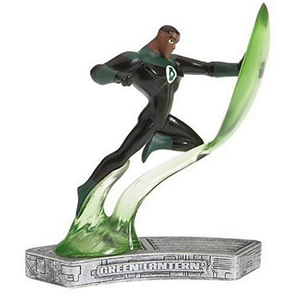
greenlanternresin.jpg

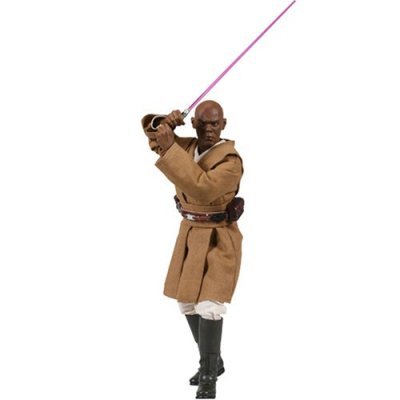
macewindu.jpg

Why I created The Multicultural Toybox

lesliepurpleblogher.jpg I’m white. My nearly two-year-old son is white. My husband is white. So is just about everyone in my extended family. Why should I care about multicultural toys?

Because I’ve always been uncomfortable with homogeneity, and I want my son to feel the same way. Even as young children, my sister and I would shift uncomfortably and point out when we were among only white people. For example, at age 10 as my sister scanned the crowd at a local church’s holiday craft fair, she announced, “It’s going to be a very white Christmas.”

When it comes time to open presents, I don’t want all my son’s Christmases to be white. I want him to have a variety of playthings that are fun and educational and sustainable. And I want people of color to be represented on and among these toys because as a Californian that’s the world he lives in.

The Multicultural Toybox also represents my commitment to human and civil rights. I grew up in a household that, while not explicitly antiracist, embraced progressive values. I remember asking my mother in first grade: “What’s a fag?” After ascertaining I had heard this word on the playground, she explained that “fag” is a derogatory term for gays, and that I shouldn’t use it. And I asked her about gays, and she said “It’s when a man loves a man or a woman loves a woman. And that’s okay.”

My interest in cultural differences, in whiteness, and in gender led me to pursue (and finish!) a Ph.D. in cultural studies. Much of what you read on this site is informed by the lessons I learned in graduate school, both in class and, much more informally, as the only white person in my cohort of students. I do not write The Multicultural Toybox to “represent” or to show, in the phrase of one of my classmates, that I am “down with the brown.” Rather, The Multicultural Toybox represents a genuine search for a better world that begins with children’s playthings.

Truth be told, I care as much about ethical toys as I do about multicultural toys. We can’t always afford to keep to the most stringent standards for ethical toys, and friends and family give my son mass-produced toys that are made of plastic (and, as we learned recently from the toy recalls, lead paint) and come only with white dolls and figurines. These days, it’s expensive to have a conscience. But I try anyway, and I invite you to join me on the journey.

If you have any questions or suggestions for improving the site, or if you just want to share with me a link to a relevant toy you’ve found or created, you can always direct them to me at leslie AT multiculturaltoybox DOT com.  If you own a toy store or market a line of toys or dolls, I’d be happy to discuss advertising options with you.

Many thanks for your readership.

More terrific handmade multicultural dolls

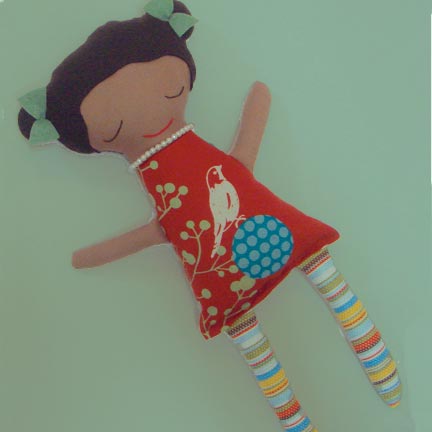
Via Strollerderby: Check out these fabulous handmade ethnic dolls from Warm Biscuit:

warmbiscuitdoll1.jpeg

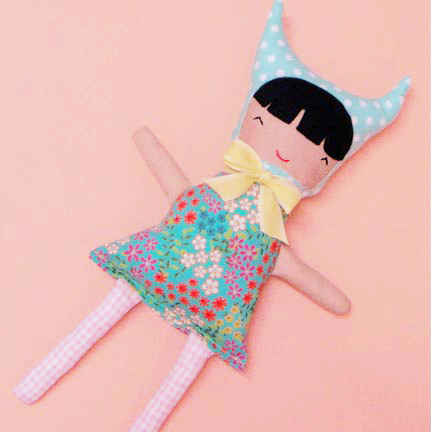
Links: doll above, doll below. Each costs $65.

warmbiscuitdoll2.jpeg

Dolls with Down Syndrome

It can be difficult to find dolls with Down syndrome, so in the post I’ll point you to some places to purchase them, as well as some information on why Down syndrome dolls are important.

This post, and yesterday’s on dolls with disabilities, were inspired by Merlene Davis’s column There’s more to diversity than color, in which she notes

But what about children with Down syndrome? What about children who can’t walk or are blind?

Why can’t they have dolls that reflect their image?

Well, truth be known, they can.

With just a few clicks of a mouse, I found dolls in wheelchairs, dolls with walkers and dolls with Down syndrome features.

Why shouldn’t those types of dolls be incorporated into this new diversity splash?

One of the big deals with the generic Kmart dolls is that they will be on the shelves everywhere, not just in neighborhoods with large minority populations.

And why do we think it is only one segment of our society that wants special dolls?

If my daughter, whose only social limitation was her heritage, could ask for a doll with special needs, why couldn’t some Hispanic child ask for an Asian doll?

Camp Venture offers soft Dolly and Danny Downs in African American, Latino, and white. Camp Venture also offers a curriculum kit to accompany the dolls.

The Pattycake Doll Company offers special needs dolls and ethnic dolls with Down syndromeUpdated 11/2009: When I first wrote this post a couple years ago, I didn’t find this doll either attractive or representative of children with Down syndrome, but I wanted to make parents aware of as many options as possible.  I have seen criticism of this doll on other websites, but I have also heard the defense that young children–special needs or no–tend to see only a doll to play with.  I also want to note that there are very few soft-form dolls with Down syndrome, and I’d love to see such dolls manufactured with features that might be more palatable to parents and to older children.

aframdollwithdown.jpg

The doll pictured above, like all the Down syndrome dolls available from Pattycake, costs $27.50. Special needs dolls are $19.95, with guide dogs and wheelchairs also available. (Speaking of ethnic dolls with disabilities, such dolls and accessories appear to be on sale at bindependent.

The website DownSyndromeDolls.com offers a small but detailed selection of dolls with Down syndrome for $50 per doll.

Downi Creations talks up the authenticity of its dolls, which exhibit the 13 characteristics of Down syndrome, including pinky fingers that curve inward, slightly protruding tongues, a gap between the first and second toes, and even a (stylized) incision on the chest to indicate open heart surgery. They have a line of eight baby/toddler dolls with Down syndrome, but at $175, they’re priced more for the collector’s market than for play. Additional outfits are available for $15-$18.

If you feel your child is not interested in dolls with Down syndrome, why not ask if the local public school, hospital, crisis nursery, or community center would be interested in such dolls? Many schools and nonprofit organizations would appreciate the donations of such dolls because their higher-than-average prices don’t fit into these institutions’ budgets. Go ahead. . . Do your good deed for the month and purchase some ethnic dolls, dolls with special needs, and/or dolls with disabilities and donate them to a good cause.

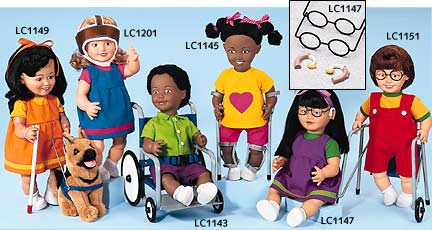
Accessories for dolls with disabilities–and some dolls with disabilities

Check out these accessories for dolls with disabilities. I especially like the tiny hearing aids and the guide dog. They’re available from Lakeshore Learning:

dollswithdisabilitiesaccessorieslakeshore.jpg

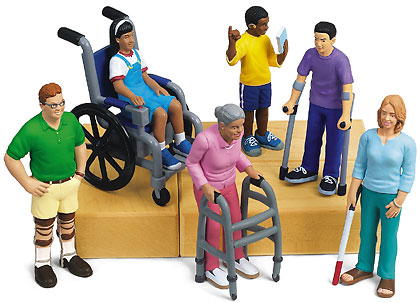
Lakeshore also offers this set of six differently abled figures, each about 5.5 inches tall, for $19.95:

peoplewithabilitieslakeshore.jpg

Also from Lakeshore: Multicultural dolls dressed for school.

Multicultural dolls and ethnic dolls: Focus on Islamic and Muslim dolls (in a U.S. context)

There’s been a lot of hubbub in the news lately–thanks to the movie based on the Bratz dolls–about the differences between Barbie and Bratz, and how the Bratz dolls are finally unsettling Barbie from her lofty perch in the toy world. (The Mirror reports that Bratz dolls are outselling Barbie 2 to 1.)

As article after article has reported, Bratz are attractive to girls because they are more ethnically diverse, they have attitude, and in an accessorizing deathmatch with Barbie, the Bratz pack might prove the winners both in terms of quantity and fashion. The result of this competition has been a pint-sized arms race of age-inappropriate sexiness. As Abby West puts it so succinctly in The Huffington Post: Bratz dolls “look like little hookers.”

What’s a parent to do? If you’re in the American mainstream, the answer seems to be “not much.” Our children are steeped in consumer culture whether we try to fight it or not, and our girls and young women are objectified at younger and younger ages, no matter what the color of their skin.

If, however, you’re outside the American mainstream–say, in an Islamic tributary of the stream–then you can throw around the weight of, well, God. And if God doesn’t want you to have sexy dolls, Missy, there will be no sexy dolls for you. End of argument.

Fortunately for girls who have outgrown plush dolls and who are hankering for plastic prototype women, some companies have answered their prayers for fun but respectable playthings.

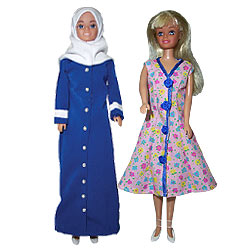
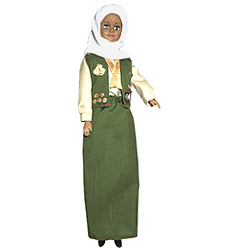
Four years ago, Michigan-based NoorArt introduced Razanne, a modest Muslim version designed to compete with Barbie among Muslim children. Razanne comes in three ethnic variations–dark skin/black hair, olive skin/black hair, and pale skin/blonde hair–and with fashions appropriate for inside the home and outside of it. Variations on her wardrobe include “Eid Mubarak” holiday garb (in pale blue or pink) for Eid, a casual but still modest playday outfit, a Muslim Scout uniform that provides full coverage, a dress for school, robes and headcoverings appropriate for the mosque, and “teacher Razanne.”

razanneinout.jpeg muslimscoutrazanne.jpeg

The NoorArt site explains that

In and Out Razanne comes with a two-piece fashion set for wear inside and outside the home. At home Razanne loves to dress in all the latest fashions. In a minute she can be ready to go out with this traditional jilbaab coat. Razanne helps Muslim girls understand that in the home they can be the ultimate fashion statement yet still have attractive attire while dressing modestly outside the home.”

You can purchase the dolls directly from NoorArt.

If you want your dolls to have even more coverage than Razanne in her prayer robes, you can turn to Fulla, who in one iteration comes with this outdoor fashion:

fullaoutdoor.jpeg

Astrolabe Toys, which sells Fulla, describes her thus:

Straight from the Middle East, the Fulla Doll is about to make her U.S. and Canada debut! For years, the Fulla Doll has been a major source of connection and comfort for Middle Eastern and European children. Now, American girls can not only learn about a lifestyle a world away, but they can also learn core values and acceptance of other cultures. The best part is girls can learn these virtues while having fun!The Fulla Doll has elevated dolls to a whole new level — one that impacts society at the core and aims to change the world through tolerance and understanding. Fulla is not just a toy; she is an icon for children to emulate as they become strong, educated women who work to make the world a better place. She promotes self-respect and kindness towards others to help young girls gain strong virtues as they play.

Fulla comes with many clothing options, including summer wear like dresses, skirts and T-shirts. She loves to read, play sports and teach and mentor others. Fulla Doll has a complete line of accessories and fun options, like furniture and jewelry!

And just like other popular dolls, Fulla loves to shop, spend time with her friends, cook and read.

Other variations of the doll are available at Shop Fulla, Halalco, BuyItNow!, Hedeyah, and on eBay (simply search for “Fulla doll” on the auction site). Go check them out–under that abaya, Fulla has some fashion sense, and even some glam sensibilities. And you know what I like about Fulla? She appears to be an MD, as her creators offer a child-sized Fulla Doctor Trolley Play Set.

Hedeyah also offers Leen, a talking, modestly dressed Muslim doll. According to the site, “Leen. . .can recite Al-Fatehah, the first Surah in Al Quran, or sing a nice Arabic song about her mother.”

But what of dolls representing Islamic boys? Fear not–the Iranian Institute for the Intellectual Development of Children and Young Adults five years ago created Sara and Dara. According to the BBC,

The children are supposed to be eight years old, young enough under Islamic law for Sara to appear in public without a headscarf.But each of the four models of Sara comes with a white scarf to cover her brown or black hair.

Another toy seller, Mehdi Hedayat, said: “Dara and Sara are strategic products to preserve our national identity.

“And of course, it is an answer to Barbie and Ken, which have dominated Iran’s toy market.”

Like what you see here, and want more? Subscribe to the Multicultural Toybox’s RSS feed.

Harlem kids make multicultural dolls thanks to Crafty Kids nonprofit

Clem Richardson of the New York Daily News shares the story of a program in Harlem that teaches kids to make their own multicultural dolls. About toymaker Kara Lesondak, Richardson writes,

[S]he taught the mostly African-American and Hispanic students to make and market dolls that looked like them.”Kara created a very unique doll-making program for us,” said East Harlem Tutorial executive director Alex Betancourt. “These weren’t your Madison Ave. portrait of what dolls look like. Most of the dolls were African-American and Latino. And not only did the kids make them, they sold them, too.”

The students put some of the dolls up for auction during East Harlem’s annual fund-raiser – but not all of them.

Bravo! Lesondak has her own line of multicultural dolls, Lindie & Friends. You can purchase the dolls directly from her. Here’s a sample; isn’t he cute?

samson.jpg

His name is Samson, and he’s available for $28 at the Lindie & Friends Gallery Store.

Link love: Ethnic dolls, multicultural toys, ethical toys, multicultural superheroes, and more

Some interesting and relevant links from around the web regarding ethnic dolls, multicultural toys, multicultural superheroes, ethical toys, and more:

From The Toronto Star, The Trouble with Ethical Toys. An excerpt:

assistant professor Gavin Fridell, who specializes in fair-trade issues, doubts fair trade toys will ever have much of a market presence, since ensuring that all the parts and processes involved are completely ethical would be next to impossible.”Think of all the different sourcing you would have to do to make a toy,” says Fridell, whose book, Fair Trade Coffee: The Prospects and Pitfalls of Market-driven Social Justice, was released this year.

An action figure, for instance, needs rubber, plastic, paint, metal, hair and cloth. Ensuring all that is produced ethically would be prohibitively expensive, Fridell says, adding fair trade works best with simple products such as coffee.

Besides, he says, where fair-trade coffee has the romance of keeping small farmers on the land producing quality coffee on a beautiful mountaintop, fair-trade manufacturing is more about workers’ rights and anti-globalization.

“These are more uncomfortable ideas,” Fridell says. “The best way to buy ethical toys might be to buy locally.”

The Asian Pacific American Toy Chest, from the superheroes page:

For the early part of superhero comic history, Asians tended to be the bad guys in comics, taking roles of either Super WWII Japanese Spy or some kind of Fu Manchu emperor. But, thanks in part to Marvel Comics’ popular X-Men and the influence of anime on American comics, we are seeing more and more APA super heroes exploding onto the scene.

From Young Money, Comic Books Enrich Their Character Mix: “Comic book fantasy is believable, he says, to the extent that it’s grounded in the real world. And the real world is not exclusively white, Anglo-Saxon, male or heterosexual.”

From the librarian at The Gentle Reader, some adorable multicultural dolls: Polly, Tali, Holly, Ali, Jolly, and Molly.

The Sacramento Bee brings us From Barbie to the Bratz dolls: Do media images push girls to go too sexy, too soon?

The Diva asks for readers’ opinions on ethnic Barbies. Personally, I find all Barbies a bit creepy, but I confess to being wowed by some people’s customizations of Barbie’s wardrobe. Case in point, these customized Indian Barbies from Dolls of India.

From the Courier-Mail, A Storm over Golliwog Dolls. Read the story, and then check out the history of Golliwogs at Wikipedia and The Jim Crow Museum of Racist Memorabilia.

Shame on you, UNICEF–stop the blackface German-language ads!

UNICEF is running a series of German-language blackface ads:

unicefblackface.jpg

Click the link above for a gallery of all the ads.

Of the ads, Black Woman in Europe writes,

Besides claiming that every single person in “Africa” isn’t educated, and doing so in an extremely patronising way, it is also disturbing that this organisation thinks blackfacing kids with mud (!) equals “relating to african children”. Also, the kids’ statements ignore the existance of millions of african academics and regular people and one again reduces a whole continent to a village of muddy uneducated uncivilized people who need to be educated (probably by any random westerner). This a really sad regression.Bottom lines of this campaign are: Black = mud = African = uneducated. White = educated. We feel this campaign might do just as much harm as it does any good. You don’t collect money for helping people by humiliating and trivializing them first.

Etsy finds: adorable ethnic dolls and multicultural dolls

Found on Etsy.com

These two adorable ethnic dolls are available in germandolls’ Etsy shop:

mochawaldorfbabydoll.jpg

sweetheartaframwaldorfdoll.jpg

If you purchase these ethnic dolls, please let the artist know you saw them on MulticulturalToyBox.com! Thanks!